The GTA housing market tipped back toward buyers in September, but central Toronto held up better than most of the region. Across the GTA, sales fell 9.0% from a year ago to 5,040, the steepest annual drop since January. The average price slipped 5.1% to $1,006,409, a 20th straight month of year-over-year declines.
Sellers pulled back too. New listings fell 14.4% to 16,500, yet the sales-to-new-listings ratio still dropped to 31% from 42% in August. Months of supply rose to 5.2, above five for the first time since January.
Toronto Central by the numbers
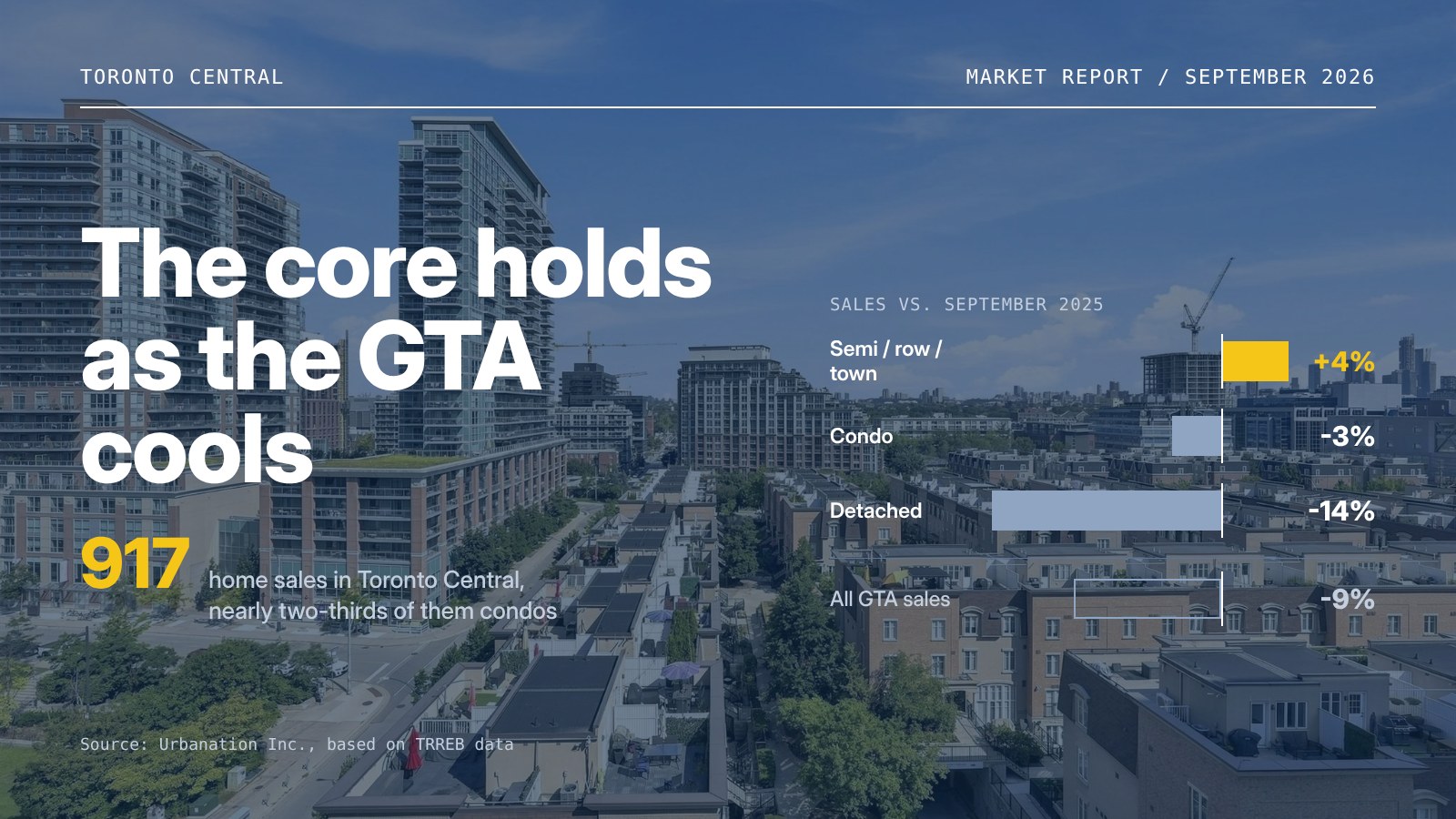
Toronto Central recorded 917 sales in September, and nearly two-thirds of them were condos. Each housing type told a different story.
| Housing type | Sales | Sales change (Y/Y) | Average price | Months of supply |
|---|---|---|---|---|
| Detached | 180 | -14% | $2,351,668 | 6.4 |
| Semi / row / town | 144 | +4% | $1,294,618 | 4.1 |
| Condo apartment | 593 | -3% | $683,259 | 6.0 |
Semis, rows and townhouses were the bright spot. Central was the only area in the GTA where sales in this category grew, up 4% while the category fell 11.2% region-wide. At 4.1 months of supply, it is also the tightest part of the central market.
Detached homes were the soft spot. Sales fell 14%, against a 4% dip for the City of Toronto overall. Supply of 6.4 months was the highest of any area in the GTA for detached homes, giving buyers at the $2.35 million average real room to negotiate.
The downtown condo market
Central Toronto condos were the most resilient condo market in the GTA. Sales slipped just 3% to 593, compared with a 7.8% decline across the GTA and a 12% drop in the 905. Central accounted for two of every three condo sales in the City of Toronto.
The $683,259 average was the highest condo price of any area, well above the GTA average of $605,257. That GTA figure fell 7.7% and is the lowest for any September since 2019. Central supply sat at 6.0 months, slightly below the GTA condo figure of 6.3.
GTA-wide, condo buyers are clustering at the entry level. Units under $500K made up 45% of condo sales, up from 27% a year ago, and were the only price band to post growth (+54%). The $1.5M-plus segment held its 3% share, while every band in between lost ground.
Supply is adjusting as well. New condo listings fell 14% and have now declined for 13 straight months, as investors hold units as rentals and the wave of new completions passes its peak.
The city keeps outperforming the 905
The City of Toronto again outpaced the surrounding 905 on sales in every housing type.
- Detached: sales down 4% in the city versus 12% in the 905, with supply of 4.5 months against 5.3.
- Semi / row / town: average prices rose about 2% in the city and fell about 5% in the 905.
- Condos: sales down 5% versus 12%, and prices down 6% versus 12%.
Urbanation attributes the gap to the pull of the urban core, its diverse end-user base, and a selective return of investor interest to well-located product.
What is driving the slowdown
The report points to confidence and borrowing costs rather than economic fundamentals. Trade tensions flared after Canada walked away from talks with the United States, and the share of Canadians expecting higher home prices fell to 33% from 38%.
Borrowing costs also moved up. The five-year Government of Canada bond yield climbed from about 3.3% to 3.7% during the month, pushing discounted five-year fixed mortgage rates into the mid-4% range. The Bank of Canada has held at 2.25%, and markets now expect its next moves to be increases, with the October 28 decision seen as close to a coin flip.
The underlying economy remains stable. Toronto employment is still growing and Ontario’s GDP expanded at a 3.3% annualized pace in the second quarter.
What it means for buyers and sellers
Buyers in central Toronto have leverage and little pressure to rush, especially for detached homes and condos, where supply sits at six months or more. Semis and townhouses are the exception, with tighter supply and rising sales.
Sellers face a market short on urgency. Many owners who do not need to move are waiting, which is keeping prices drifting lower rather than falling sharply. With the slower winter season ahead, Urbanation sees near-term price stabilization as less likely than it looked over the summer.
A durable recovery depends on confidence returning. Until then, the urban core and entry-level demand are the market’s steadiest footing.
Source: Urbanation Inc., GTA Monthly Housing Market Report, September 2026, prepared for Royal LePage Signature Realty. Based on September 2026 data from the Toronto Regional Real Estate Board.